The Case of the Ticking Suitcase
IntermediateAges 7–812 pagesMystery
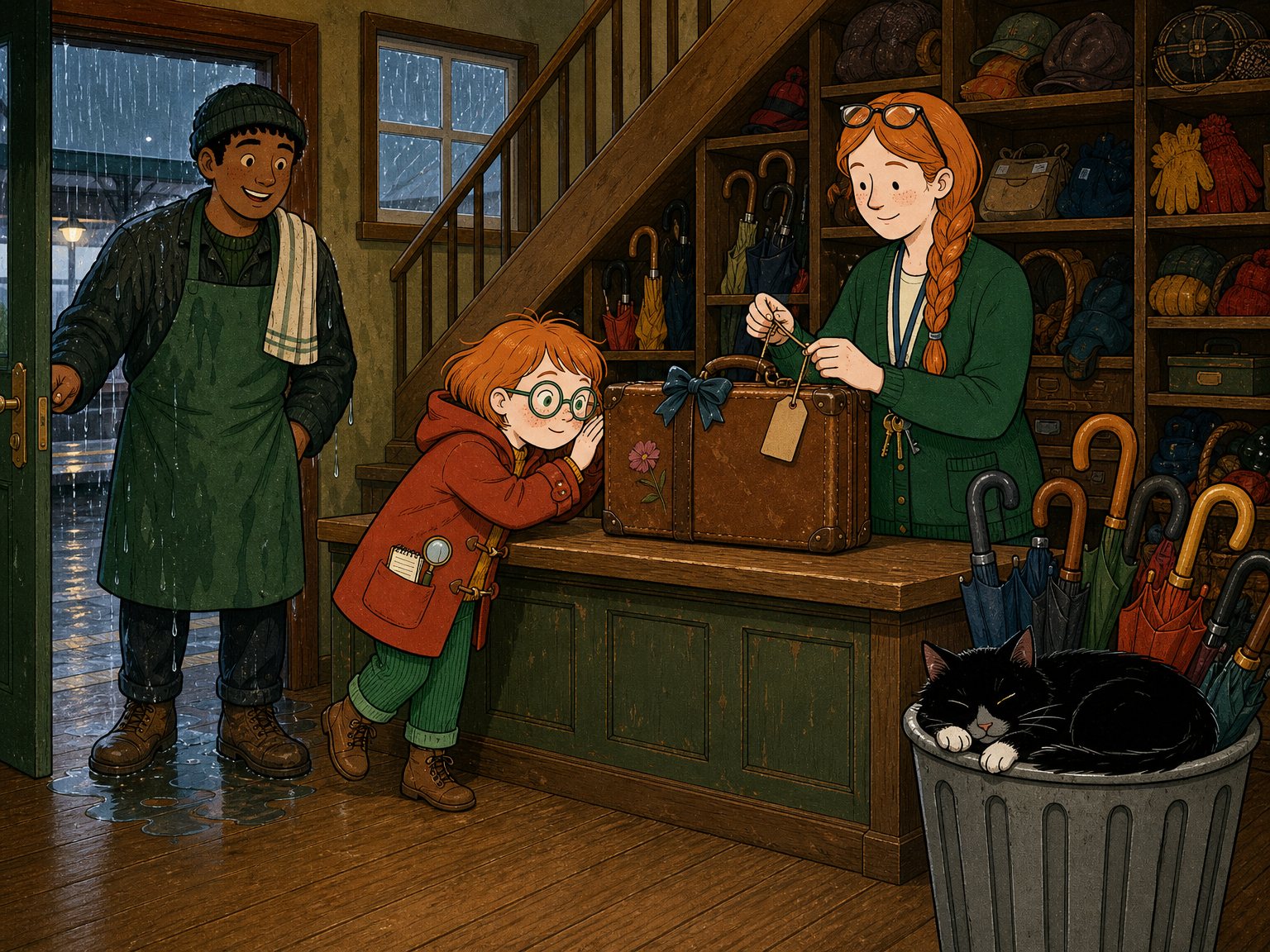
At ten past four on a rainy Saturday, the Lost Property Office smelled of wet umbrellas and warm toast. The door banged open. The coffee man squelched in and plonked a battered brown suitcase on the counter. "Found it by my cart," he puffed. "Nobody came back for it." Mum tied on a blank brown tag. Captain did not wake up. Kit leaned closer. She had a feeling. Detectives always have a feeling. She pressed her ear to the scuffed brown leather. Tick. Tick. Tick. The suitcase was TICKING.
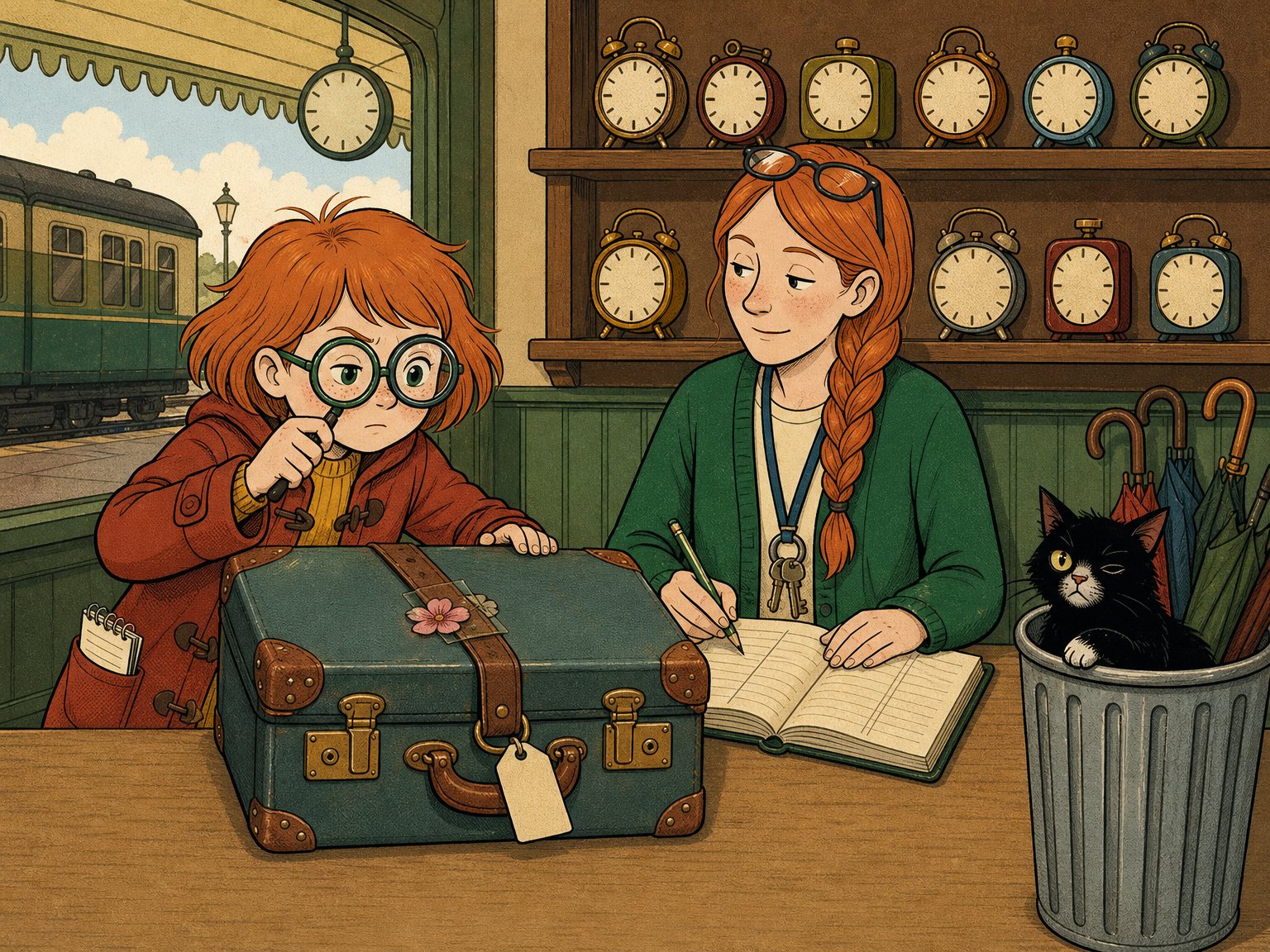
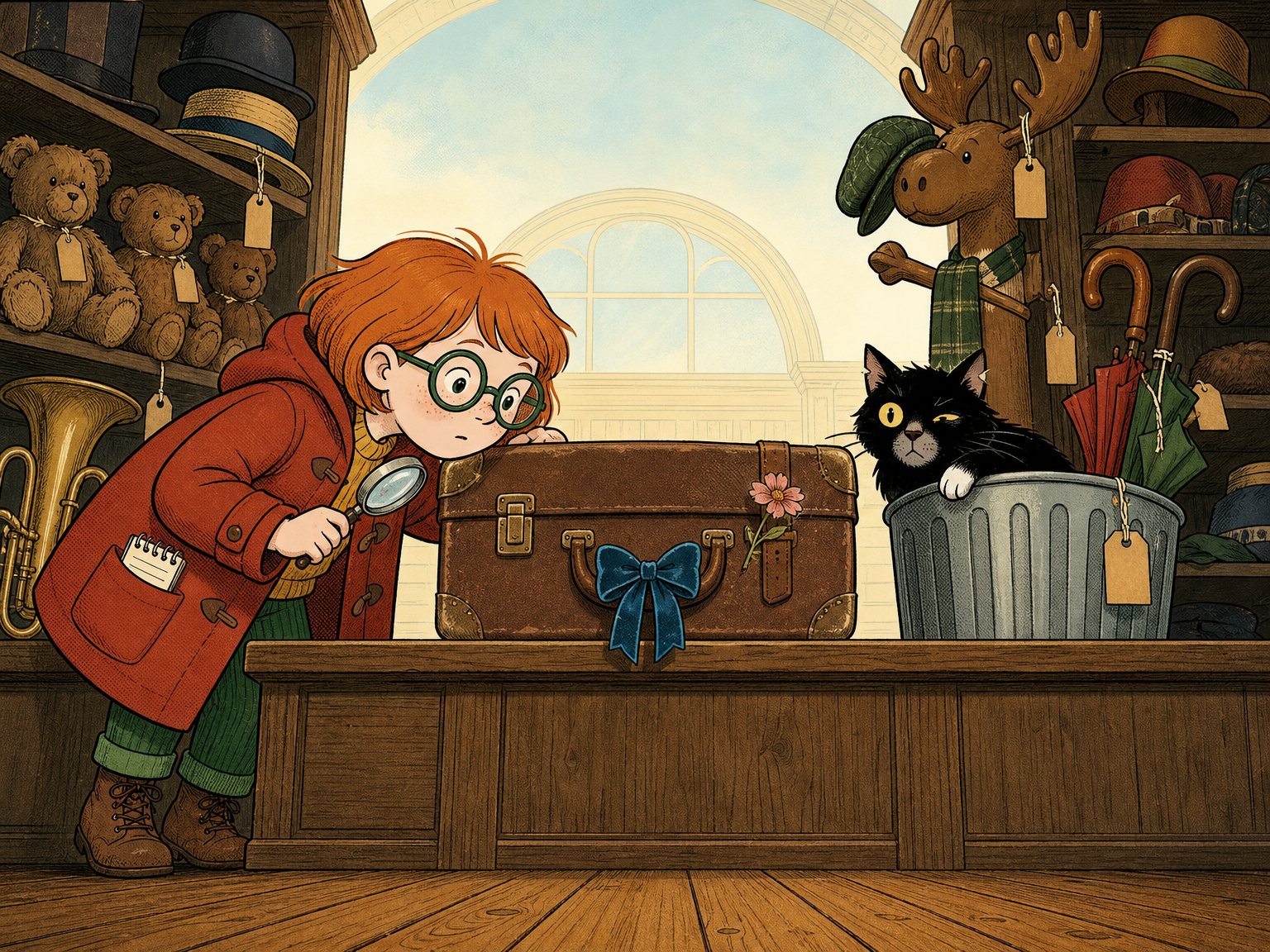
"Mum! It's ticking!" "Probably an alarm clock," said Mum, without looking up. "We get eleven a week." But Kit already had her magnifying glass out. This was not a case for an ordinary girl. This was a case for Detective Kit. Clue number one: the ticking. Steady and patient, like a heartbeat, only tidier. "Interesting," said Kit. She narrowed her eyes. "Mum. What if it's a time machine?" "Then its owner will come and collect it yesterday," said Mum. Kit opened her mouth. Then she shut it. That was, annoyingly, a good point. In the umbrella bin, Captain was awake, staring at the suitcase strap.
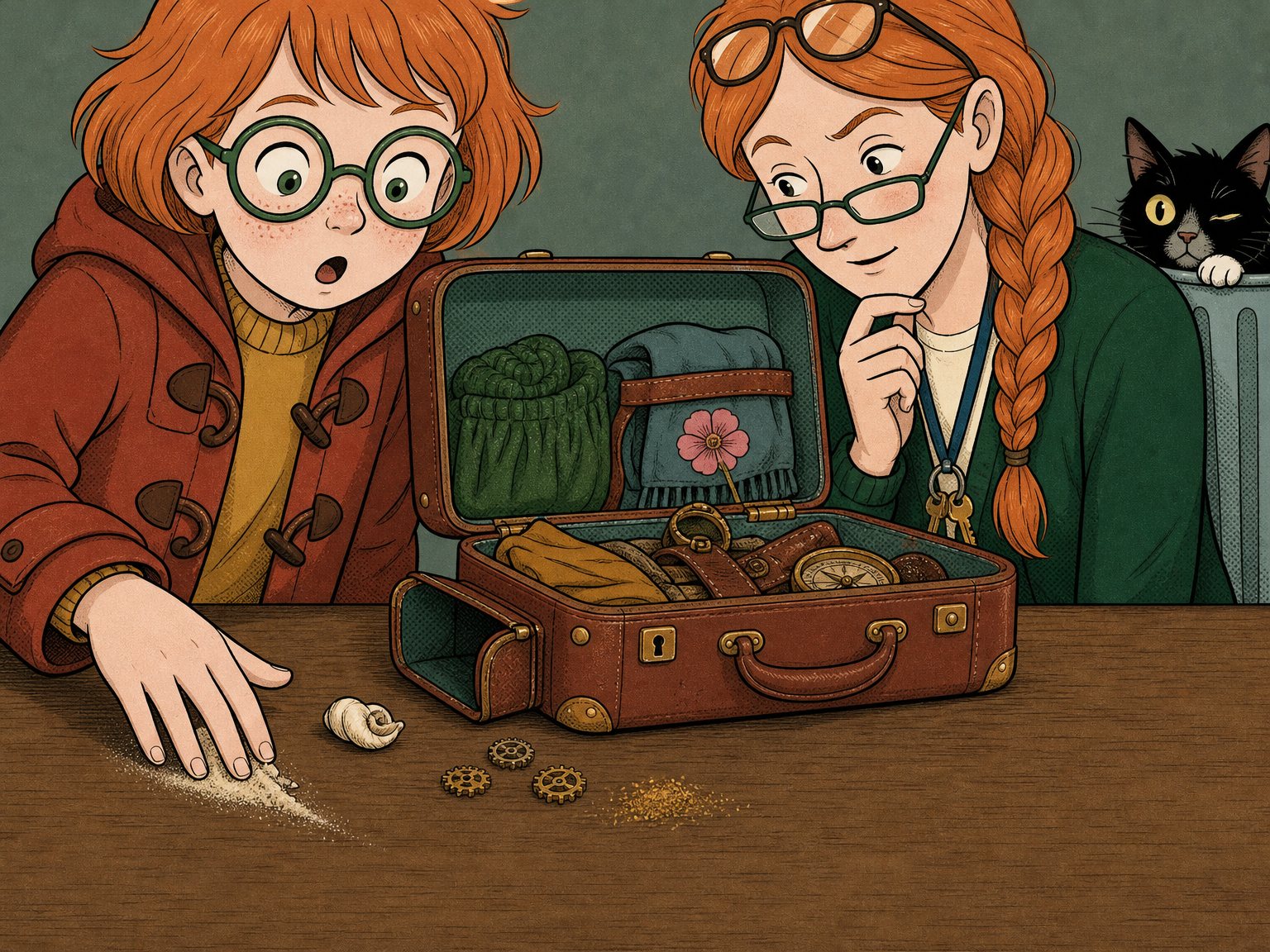
Clue number two was hiding in the little side pocket. Kit shook it out. Down pattered golden sawdust, exactly three tiny brass cogs, a pinch of gritty sand and one curly white shell. "Interesting," whispered Kit. She swept the sand and the shell aside. Beach dust. Irrelevant. Cogs meant machinery. Machinery meant... "A robot spy!" she gasped. "Taken to pieces and smuggled across the country!" Mum pulled her reading glasses down, peered at the cogs, and pushed them back up. "A spy who leaves bits of himself in his pockets," she said. "Not a very good spy." Kit crossed out ROBOT. "Fair point." In the umbrella bin, Captain's one eye still had not moved. He was not looking at the cogs.
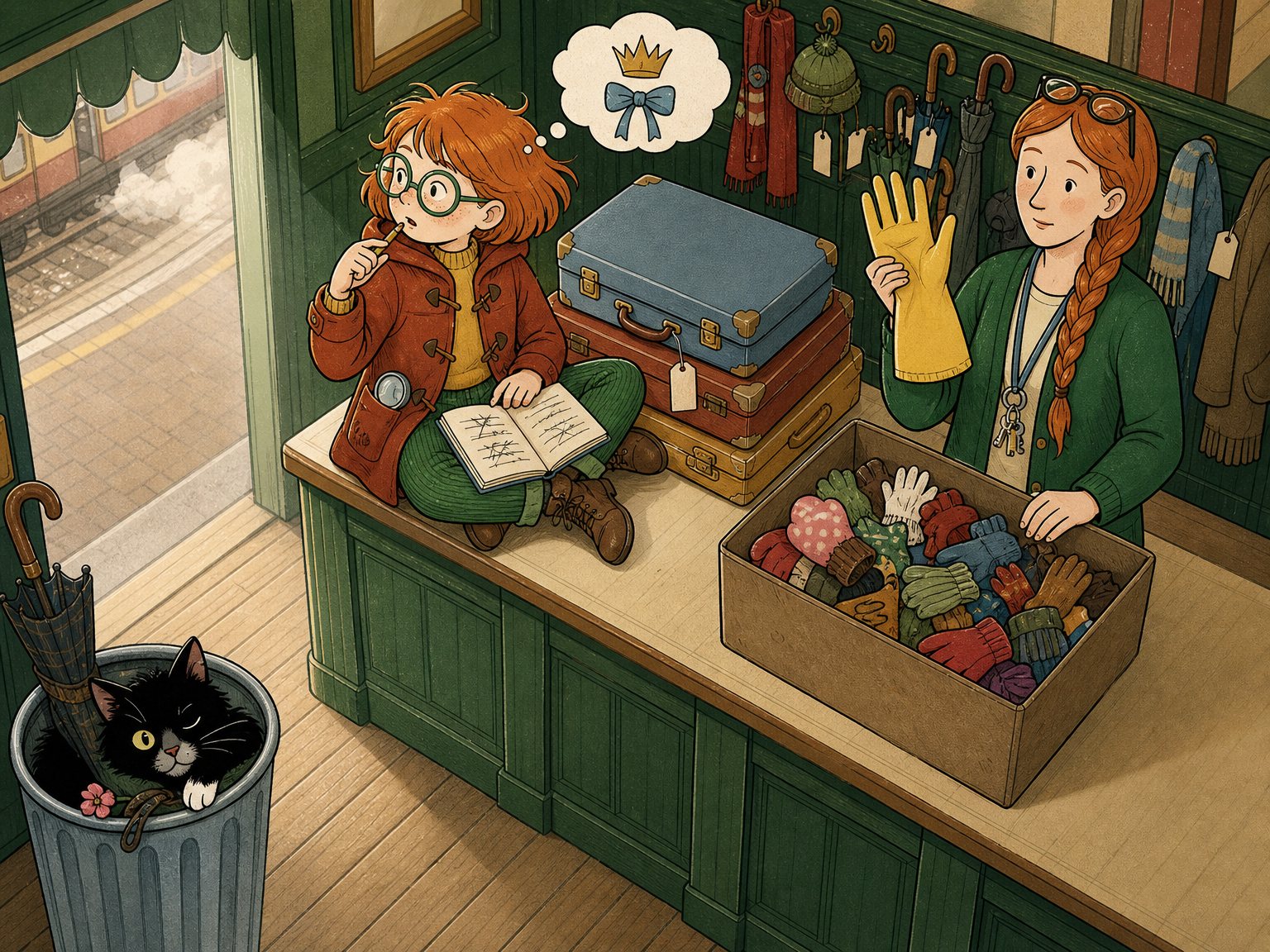
Clue number three was tied to the handle: a velvet ribbon, blue as a swimming pool, in a bow so neat it looked ironed. "Very interesting," said Kit. A bow like that meant somebody important. "Mum," Kit whispered. "It's a royal gift. Stolen from a palace. We should ring the King." "The King," said Mum, sorting odd gloves, "doesn't do Saturdays." Kit sniffed the leather. Clue number four: engine oil and lemon polish, like a bicycle that had been to a wedding. "Interesting," said Kit, and sneezed. Four clues. No answer. Kit chewed her pencil until it went soggy. Then, from out in the station, came a sound. Squeak. Squeak. Squeak.
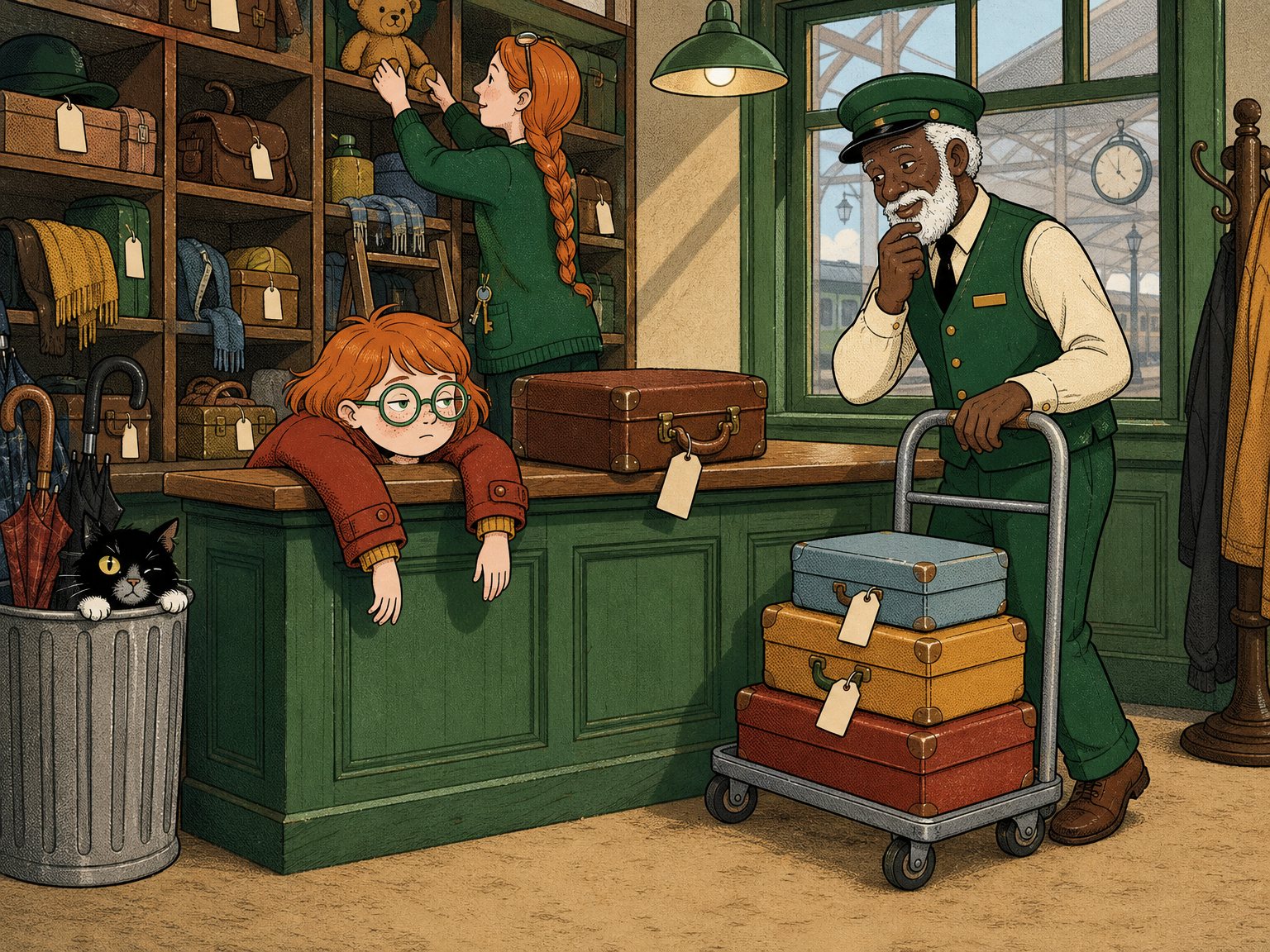
Mr Okafor wheeled his trolley up to the counter and tipped his cap. "Good afternoon, Detective. What have we here?" Kit flopped her chin onto the counter like a wet sock. "I've ruled out a time machine, a robot spy and a stolen royal gift." She sighed. "Well. First I ruled them in. Then I ruled them out." "That is how ruling works," said Mr Okafor. He stroked his white beard, very slowly. "Tell me. Who uses tiny cogs?" "Robots," said Kit. Then she listened to the ticking. "Or... people who make clocks?" "Hmm," said Mr Okafor. "And who ties a ribbon on a suitcase?"
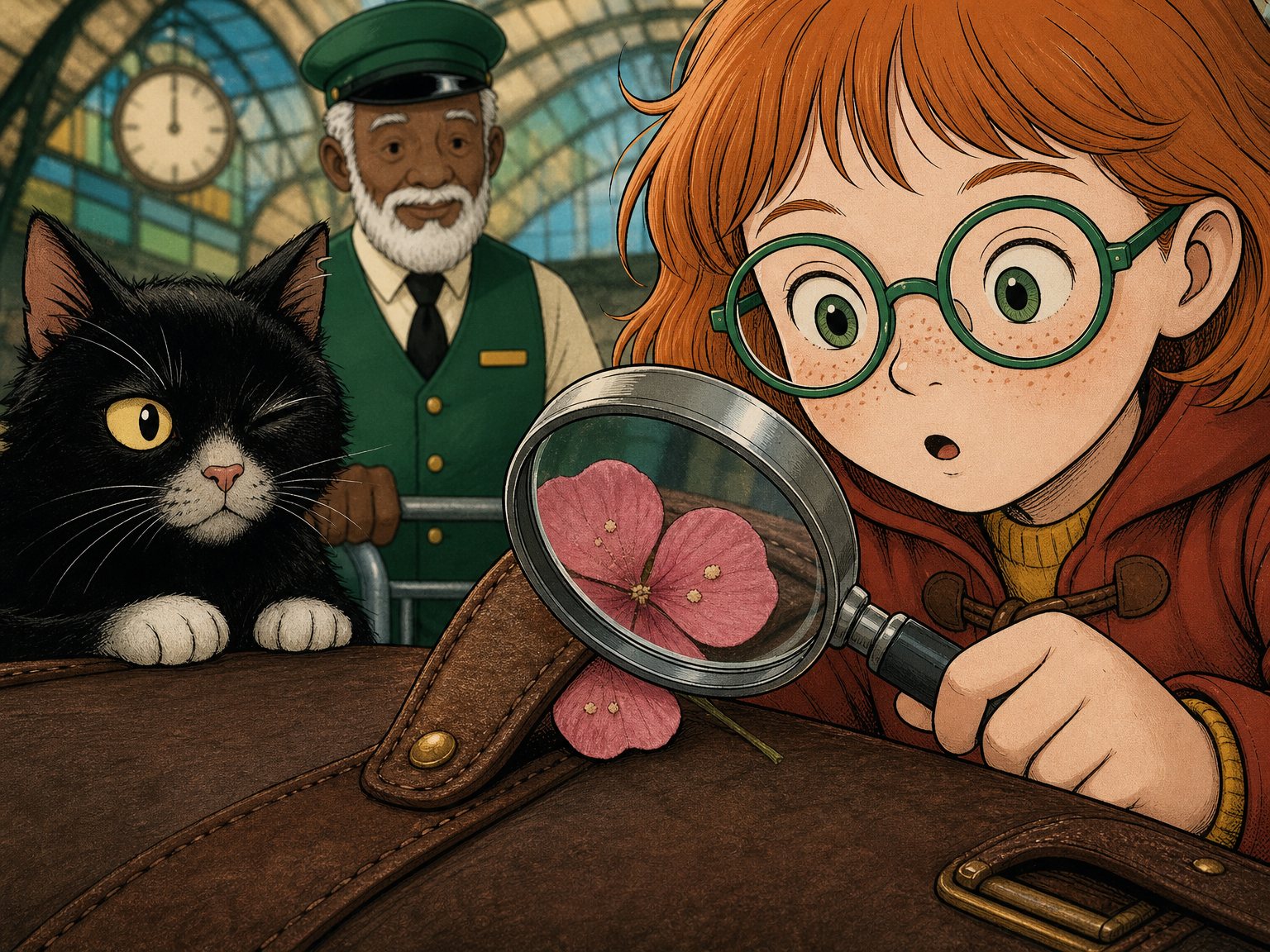
Kit thought of her own birthday presents. Every single one had a bow. "Somebody giving a present," she said slowly. "Hmm. And who would be in a hurry today?" Kit frowned. It was a railway station. Everybody was in a hurry. Then she noticed Captain. His one eye had not moved for an hour. A good detective always follows the witness's gaze. Kit followed it. Under the strap, flat as paper, was a tiny pressed flower, pink as a seashell. Caught in its petals were three grains of sand. Sand. Just like the sand she had swept aside. "Oh," said Kit. "Oh. Interesting." "Then here is a riddle," said Mr Okafor. "Where does a flower like that grow? Somewhere that waves all day, but never says hello."
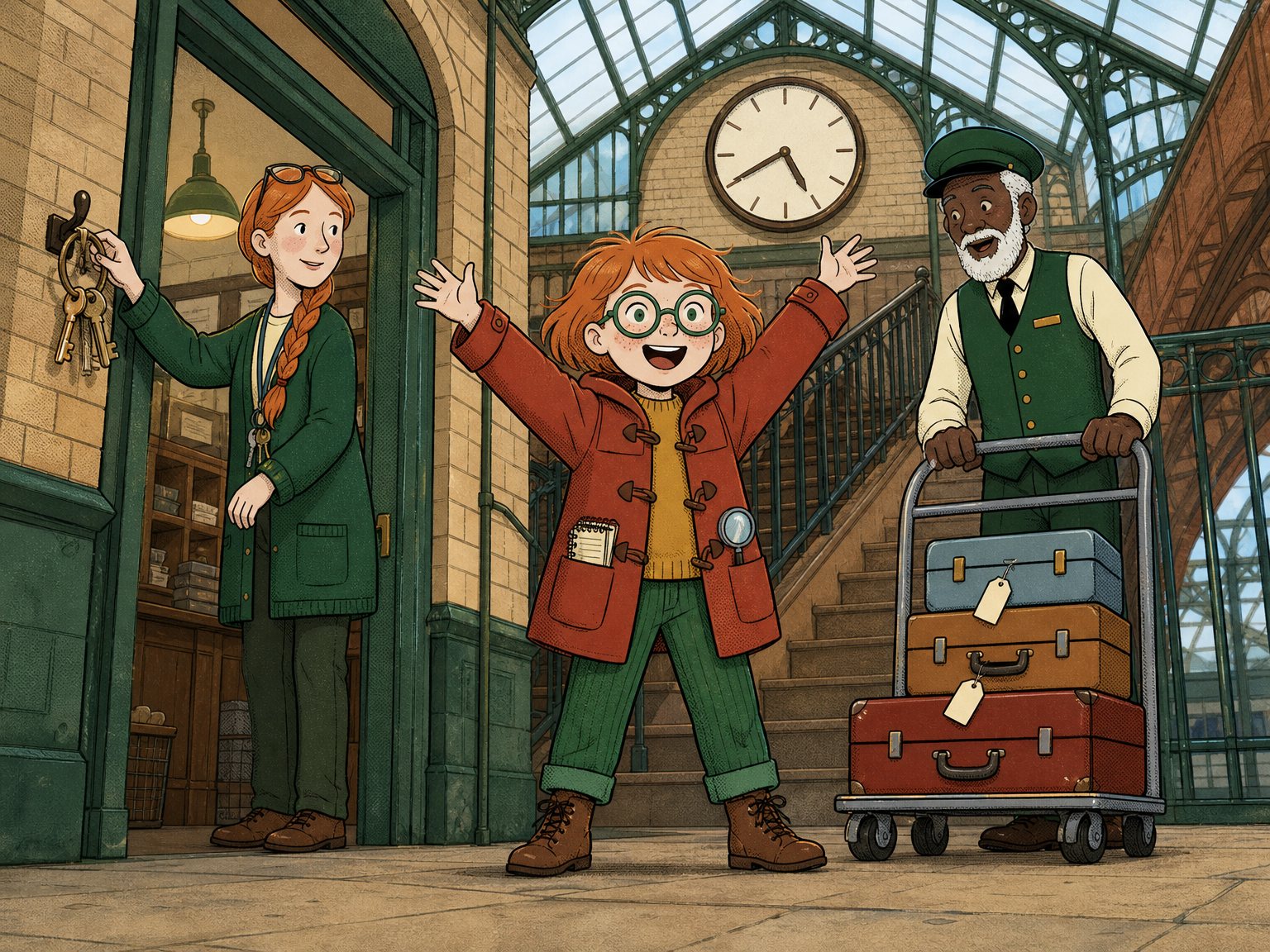
Kit's mouth fell open. Waves. Sand. Shells. "The SEA!" Her notebook pages flapped. "A clockmaker, with a present, going to a birthday at the seaside! And birthdays don't wait. That's who's in a hurry!" Mr Okafor's eyebrows rose. "Now that rings a bell. An old gentleman with oily fingers asked me for the seaside train. He caught the five past four." "Without his suitcase," said Kit. "He put it down at the coffee cart!" She looked at the big clock. Nearly twenty to five. The next seaside train left at a quarter to. Six minutes. "Lost things stay in the office," said Mum. "That's the rule." "It isn't lost," said Kit. "It's late." Mum grabbed her keys.
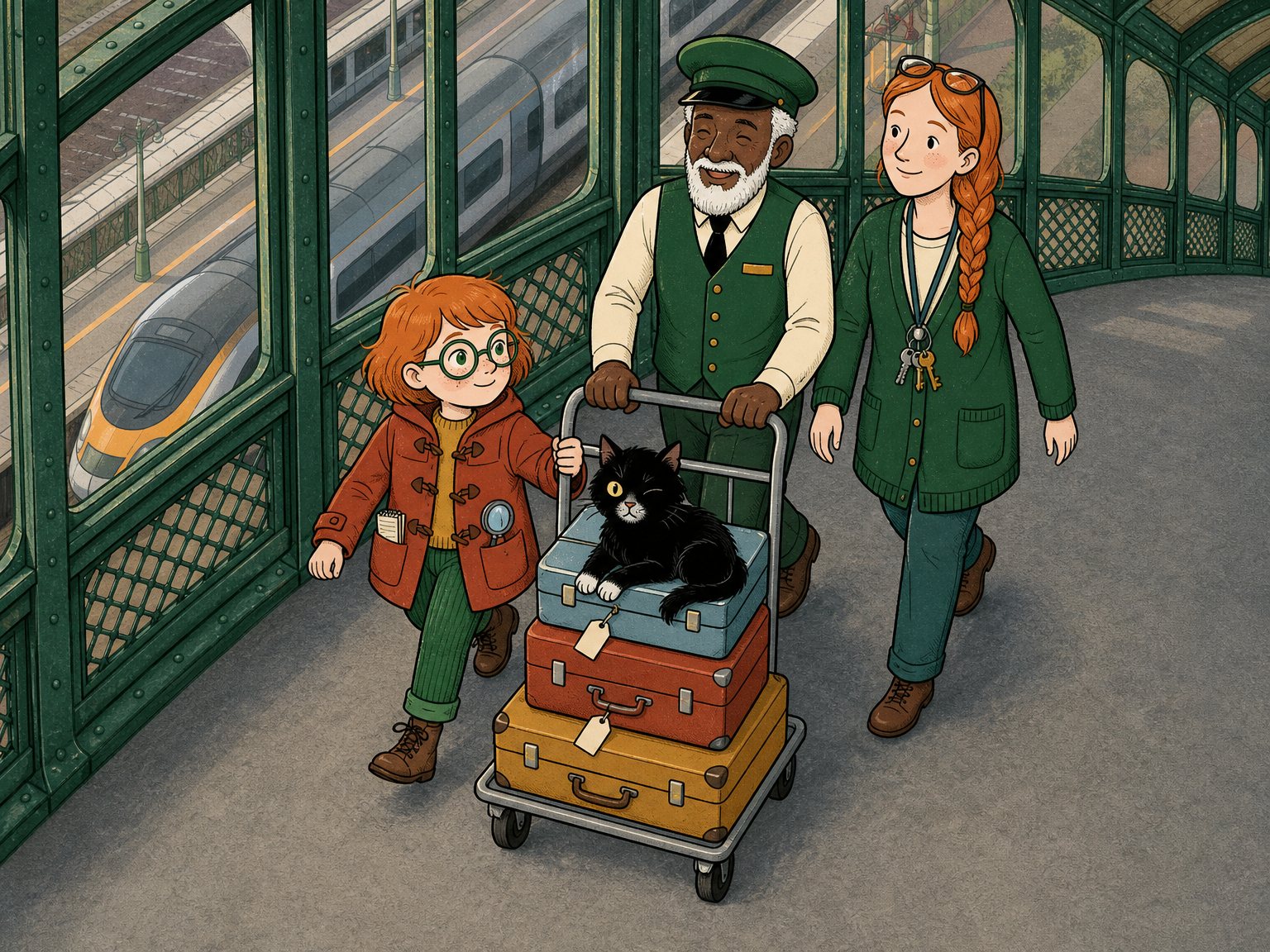
Captain leapt onto the suitcase. The suitcase went on the trolley. And the trolley went... Squeak-squeak-squeak-squeak! Across the shiny floor. Past the coffee cart, where the coffee man cheered. Into the lift, up and over the footbridge, and down again, well back from the platform edge the whole way. "Nobody runs on my station," puffed Mr Okafor. "But nobody said anything about very fast walking." He left his trolley with a guard he knew. Kit hugged the suitcase, Mum scooped up Captain, and they stepped on board. The doors slid shut. The train began to roll. Quarter to five. Fourteen minutes to the sea. And a birthday that would not wait.
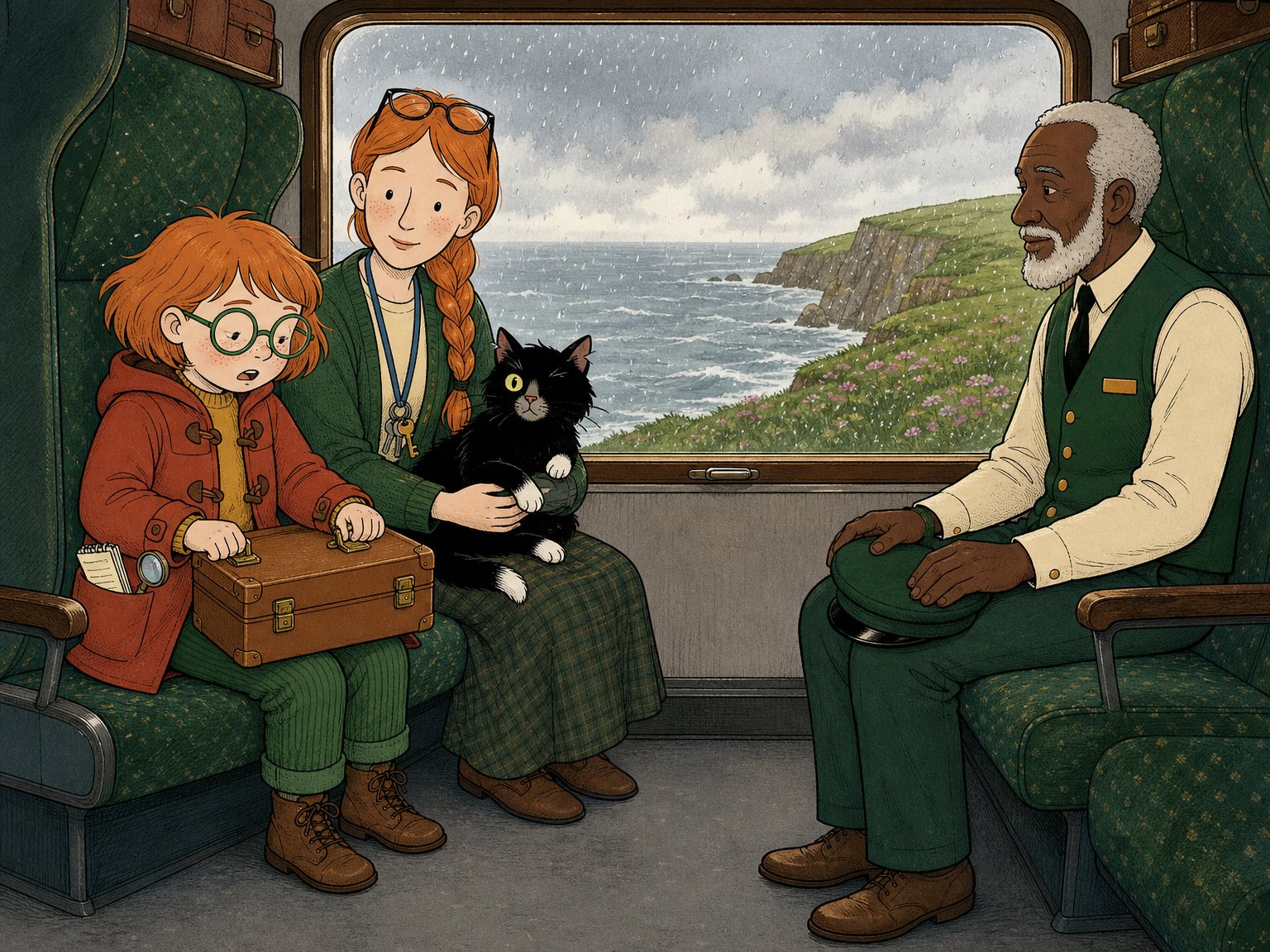
The train rocked. Kit held the suitcase on her lap, both thumbs pressed tight on the brass latches. She counted the ticks. She lost count. She started again. "What if he's gone home?" she whispered. "Then we'll have a very nice trip to the seaside," said Mr Okafor, "and a very good question for the ride back." Outside, the rain thinned. The sea appeared, grey and silver and enormous, and the cliffs were freckled pink with tiny flowers. The train sighed into the little station at the end of the line. On a bench sat a small round man, staring at his empty hands. Beside him, a girl in a yellow dress held three balloons. Nobody was smiling.
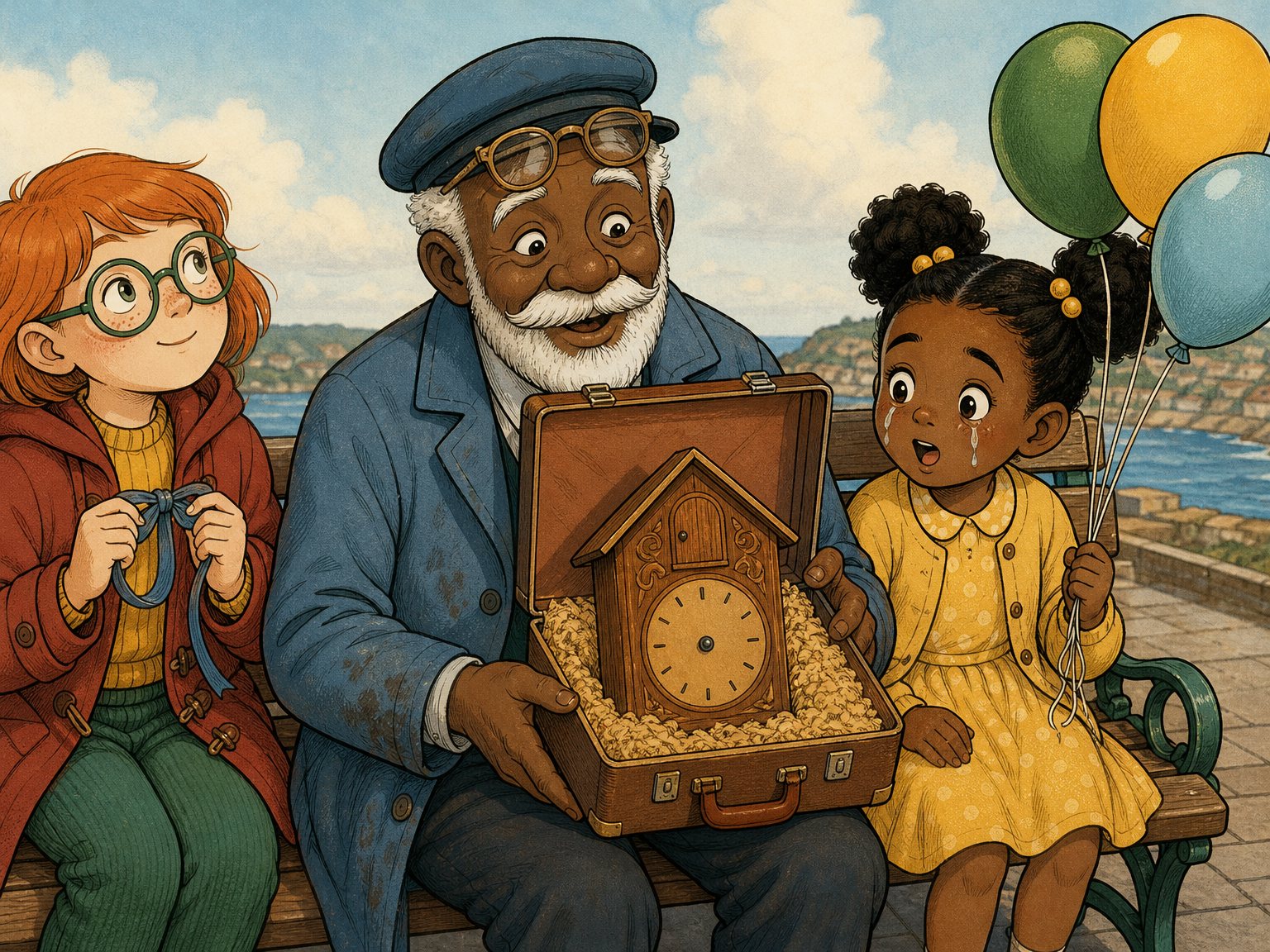
Kit took a deep breath and marched up to the bench. "Excuse me," she said. "I believe this is yours. It's been ticking." "Grandad's been sad all afternoon," whispered the girl. "I've counted my balloons a hundred times. There are still only three." The old man looked up. His face went from grey to golden, like a lamp being switched on. With shaking, oily fingers he untied the blue bow and lifted the lid. Inside, nested in sawdust, was a clock shaped like a tiny wooden house. It gleamed. Polished, Kit noted. With lemons. "Happy seventh birthday, Nia. The bird comes out at five o'clock. The very minute you were born." Kit looked up at the station clock. Its long hand was creeping... creeping...
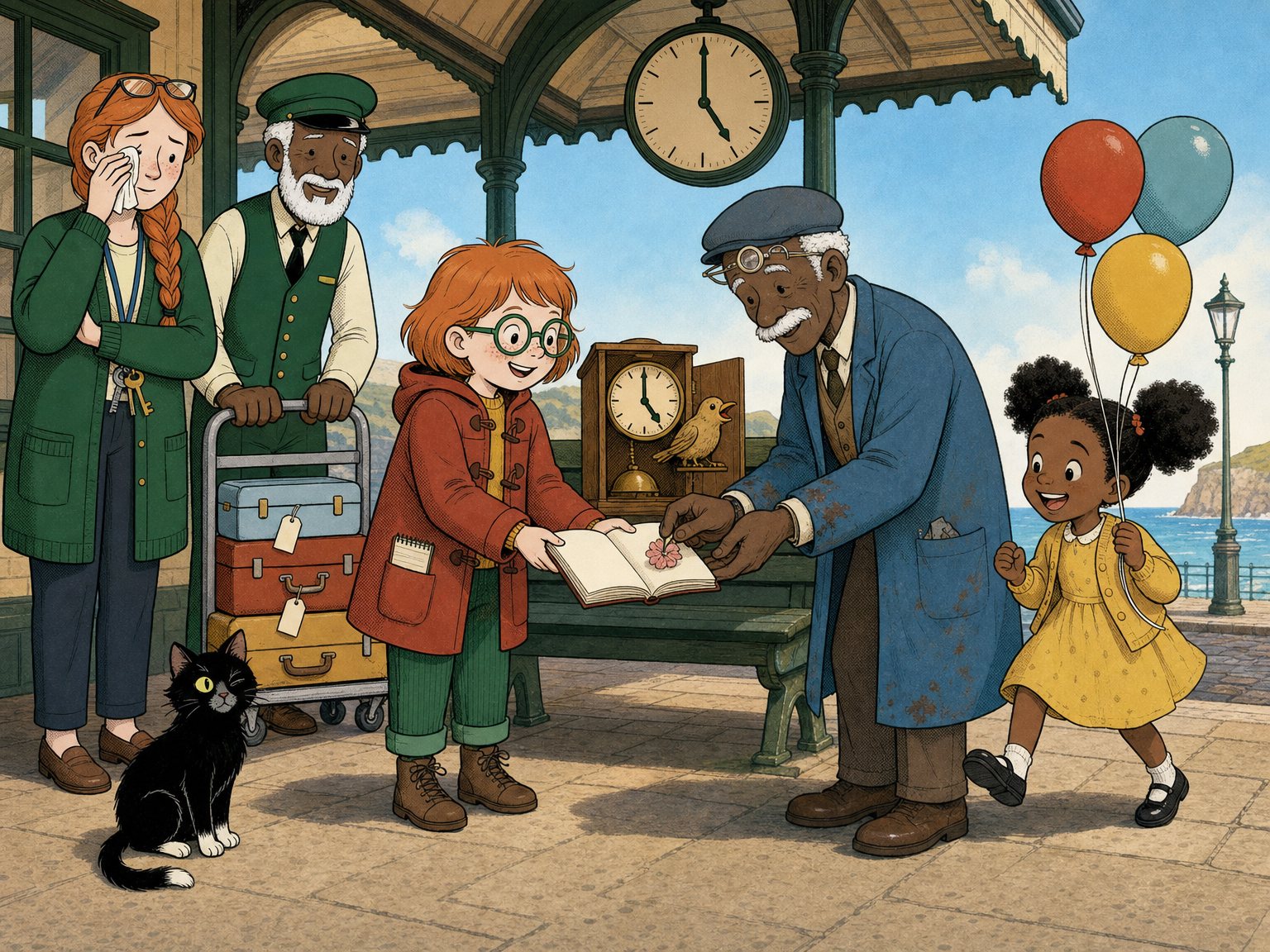
Click. The tiny door flew open. Out popped a little wooden bird, and it sang. Once, twice, three times, four times, five. Nia squealed so loudly that all three balloons bobbed. The clockmaker wiped his eyes with an oily cuff. Mum wiped hers too. "Hay fever," said Mum firmly. Nobody believed her. "I thought it was a time machine," Kit admitted. The clockmaker chuckled. "Clever girl. It is, a bit. It brings back the same happy minute every single day." Then he slipped the pink flower out from under the strap and tucked it into Kit's notebook. "A thank-you," he said, "from the seaside."
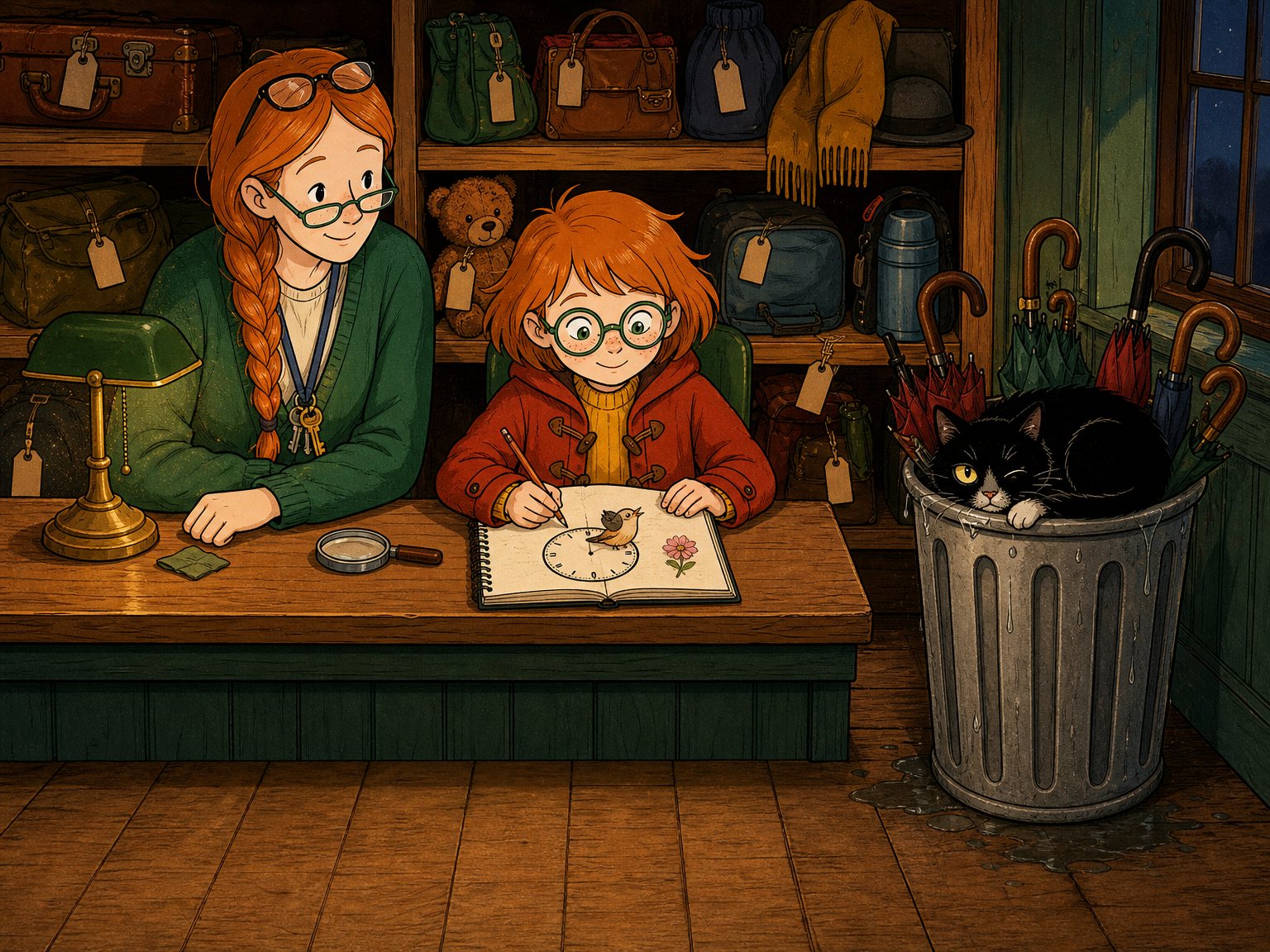
That evening, back in the Lost Property Office, the rain drummed on the glass roof and the umbrellas dripped in a row. Kit opened her notebook to a fresh page. She didn't write a single word. She drew a clock with a bird popping out, and pressed the pink flower beside it. Mum read over her shoulder. "Eleven alarm clocks a week," she said. "And never once a bird." Then she looked at the umbrella bin, where a certain scruffy cat was pretending to be asleep. "Interesting," said Mum. Captain opened his one eye, very slowly. And winked.
The end
Want a story starring your child?
Tell Bookybara an idea and it paints a brand-new illustrated story around your child’s name, age and reading level — ready before bedtime.
iPhone, iPad & Android · Free to start